By now you know how to verify a contract address and read a token’s market cap. There’s a third number worth checking before you ever click buy: how many wallets actually hold the supply. This is holder concentration — and it’s one of the fastest ways to tell whether a token is broadly held or quietly controlled by a handful of wallets that could crash the price the moment they decide to sell.
What Is Token Holder Concentration?
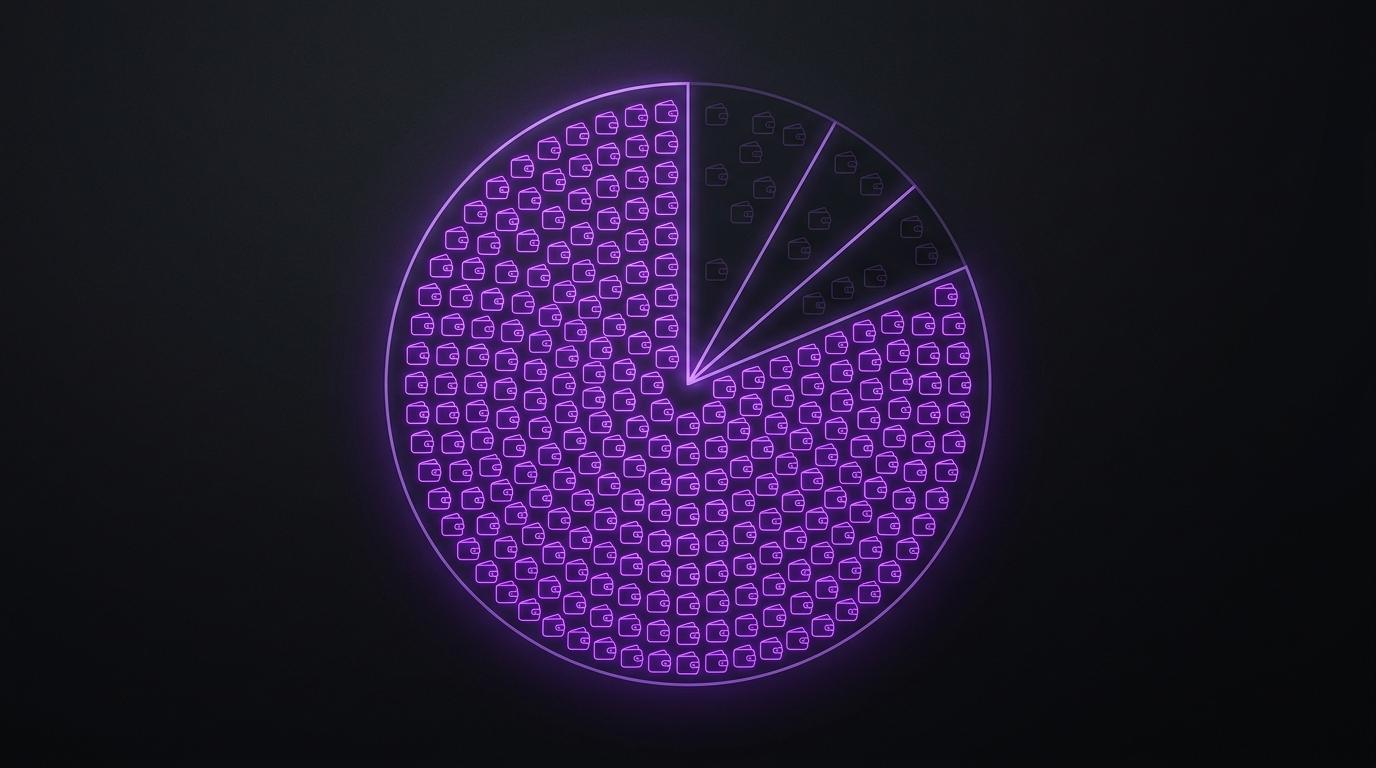
Token holder concentration describes how a coin’s total supply is spread across the wallets that hold it. A token with healthy distribution has its supply spread across hundreds or thousands of independent wallets, none of which could move the price alone. A concentrated token has most of its supply sitting in a small number of wallets — sometimes just five or ten — which means a handful of decisions can swing the entire chart.
Every blockchain explorer that shows a token’s holders will rank them from largest to smallest and show what percentage of the total supply each wallet controls. That ranked list is what you’re screening when you check for concentration.

Why It Matters for Meme Coin Traders
Meme coins launch with small, thin liquidity pools — you already know from checking market cap that a low float can make price swing hard on small trades. Concentration compounds that risk. If one wallet holds 15% of supply, that wallet alone can sell into thin liquidity and crater the price, regardless of how much genuine community interest exists. Watching top holder percentages is how you separate organic, broadly-owned tokens from ones a small group can walk away with.
How to Check Top Holder Data
You don’t need advanced tools for this — the same block explorers you use for contract address verification usually show holder breakdowns for free:
- Paste the token’s contract address into a Solana explorer such as Solscan or Birdeye.
- Open the “Holders” tab.
- Note the percentage held by the top 10 and top 20 wallets combined.
- Check whether any single wallet — outside a labeled exchange or LP — holds an outsized share on its own.
- Cross-reference with a screener like RugCheck or DexTools’ Bubblemaps view, which visually clusters wallets that may be linked to the same entity.

What Counts as “Too Concentrated”?
There’s no single official cutoff, but these rules of thumb are widely used across the meme coin screening community:
- Top 10 wallets holding more than 50% of supply is generally treated as a concentration warning sign.
- A single non-exchange, non-LP wallet holding more than roughly 5% of supply on its own is worth a second look.
- The tighter and more even the spread across many small wallets, the more organically the token tends to trade.
Treat these as guardrails, not guarantees. A token can pass every threshold and still be risky for other reasons, and a token can fail one of these and still be fine if the concentrated wallets are explainable (see below).
Not Every Top Holder Is a Red Flag
Before you panic over a big percentage next to an unfamiliar wallet, check what kind of wallet it actually is. Explorers usually label the obvious ones:
- Centralized exchange wallets (Binance, Coinbase, etc.) often appear near the top simply because they custody deposits for thousands of users — not because one person controls that stake.
- Locked or burned liquidity pool wallets show a large balance that is provably unable to move.
- Staking or vesting contracts hold tokens under a schedule, not at a whale’s discretion.
Anonymous wallets with no label holding a large, freely-movable share are the ones that deserve real scrutiny.
How This Connects to Sniper Wallets
If you’ve read the guide on sniper wallets, you already know that the earliest buyers on a new launch often end up owning a disproportionate share of supply within seconds of a token going live. That overlap isn’t a coincidence — sniper activity is one of the most common causes of high holder concentration on brand-new meme coins. Checking sniper wallets and checking holder concentration are really two angles on the same underlying risk: is this token’s supply sitting with people who bought fair and square, or with a handful of wallets positioned to exit first?
Adding This to Your Screening Routine
Holder concentration is the check that ties the other two together. A verified contract address tells you the token itself isn’t a scam contract. A healthy market cap and float tell you the price has room to move without collapsing on thin volume. Holder concentration tells you who actually controls that supply — and therefore who can crash it. Skipping this step is how traders get caught holding the bag when a handful of wallets sell in the same five minutes.
It also matters for reading the chart itself. Dip-and-recovery entries work best on tokens where the dip is driven by normal market pullback, not by a whale quietly distributing into every green candle. A concentrated token can fake a recovery — check holder movement, not just price, before you trust a bounce.
Quick Checklist
- Pull up the token’s contract address in a Solana explorer.
- Check the combined percentage held by the top 10–20 wallets.
- Identify whether large holders are labeled (exchange, LP, staking) or anonymous.
- Cross-check with a wallet-clustering tool if the ownership picture looks unclear.
- Treat >50% in the top 10, with no clear labels, as a reason to size down or pass.
FAQ
What percentage of top holder concentration is considered safe?
There’s no universal number, but many traders treat the top 10 wallets holding under roughly 30–40% of supply, with no single anonymous wallet over about 5%, as a reasonably healthy spread. Anything meaningfully above that deserves closer scrutiny.
Are exchange wallets a bad sign if they show up as top holders?
Not on their own. A labeled CEX wallet holding a large percentage usually reflects thousands of individual customer deposits, not one entity’s directional bet on the token.
Does holder concentration change over time?
Yes — it can improve as supply distributes to more buyers, or worsen if early holders accumulate more. Checking it once at entry isn’t enough for a position you plan to hold; revisit it periodically.
What tools show holder distribution for Solana meme coins?
Solscan and Birdeye both show a free holders breakdown for any SPL token. RugCheck and DexTools’ Bubblemaps view add wallet-clustering to flag wallets that may be linked.
Comments
3 responses to “Top Holder Concentration: How to Spot a Whale-Controlled Token”
[…] real numbers. A low market cap with a small float already told you liquidity was likely thin. Heavy top holder concentration told you a whale exit could move the pool violently. Watching for sniper wallets told you […]
[…] wallets overlapping with the same wallets flagged as top holders — a sign the “distributed” supply and the liquidity are controlled by the same […]
[…] who’s actually holding the supply. Before I buy anything a KOL posts, I look at top holder concentration. If a handful of wallets control most of the supply, that’s the same setup that let […]